


First Click vs Last Click Attribution: What a Real eCommerce Account Reveals
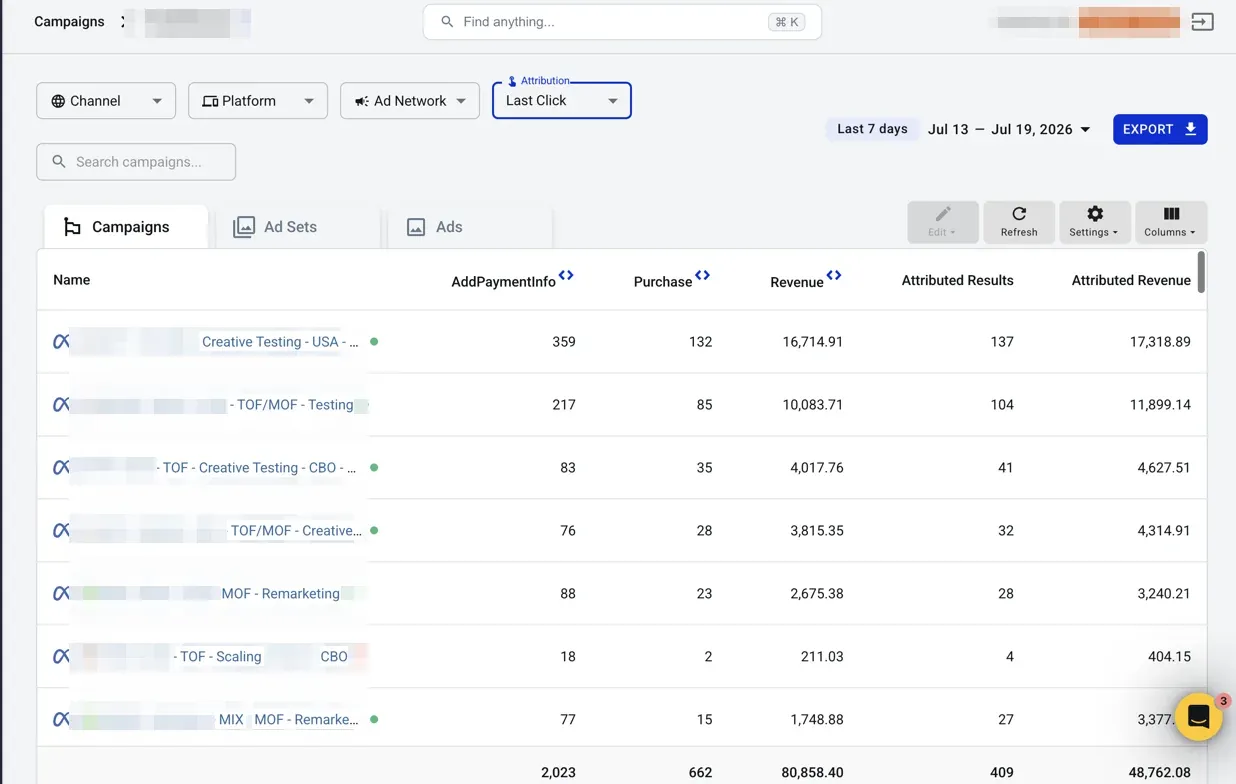
Flip one dropdown and a campaign’s purchases jump 150%. Flip it back and they fall to a third. Nothing changed in the ad account: not the budget, not the creatives, not the audiences. The only thing that changed is the question the report was answering.
That dropdown is the Attribution selector in AnyTrack’s Campaign Report, and it switches between the two questions every funnel needs answered: which campaign introduced the customer (First Click) and which campaign closed the sale (Last Click).
Last week we looked at a real eCommerce account through both lenses. The same seven days told two different stories, and the gap between those stories is where the budget decisions live.
First Click vs Last Click in 30 Seconds
Both models look at the same conversions and credit exactly one ad click for each:
| Dimension | First Click | Last Click |
|---|---|---|
| Credits | The first ad click in the visitor’s journey | The last ad click before the conversion |
| Question it answers | Which campaign brought this customer in? | Which campaign sealed the deal? |
| Tends to favor | Prospecting and creative testing (TOF) | Remarketing and retargeting (MOF/BOF) |
AnyTrack’s attribution is click-based on first-party data: an organic visit or an email click never steals credit from your campaigns, and views don’t count. Both models read the UTM parameters collected during the session, so every campaign needs its UTM template in place. (Full mechanics in First Click vs Last Click in our knowledge base.)
One Account, Two Stories
Here’s the account: an eCommerce brand running Meta campaigns, one week of data, straight from the Campaign Report (campaign names redacted). The funnel tags in the names tell you each campaign’s job: top of funnel (TOF) testing, middle of funnel (MOF) remarketing, and a MIX campaign in between. Watch the Purchase column as the view changes.
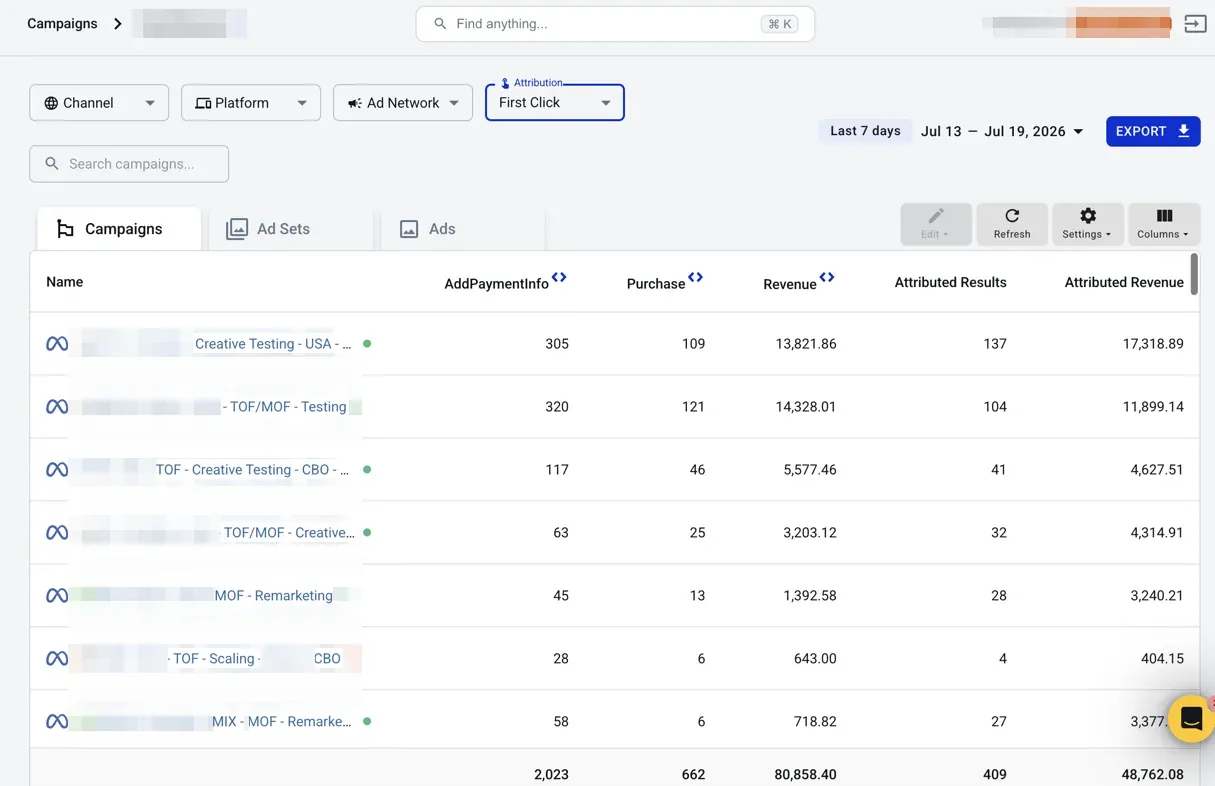
First, the week under First Click:
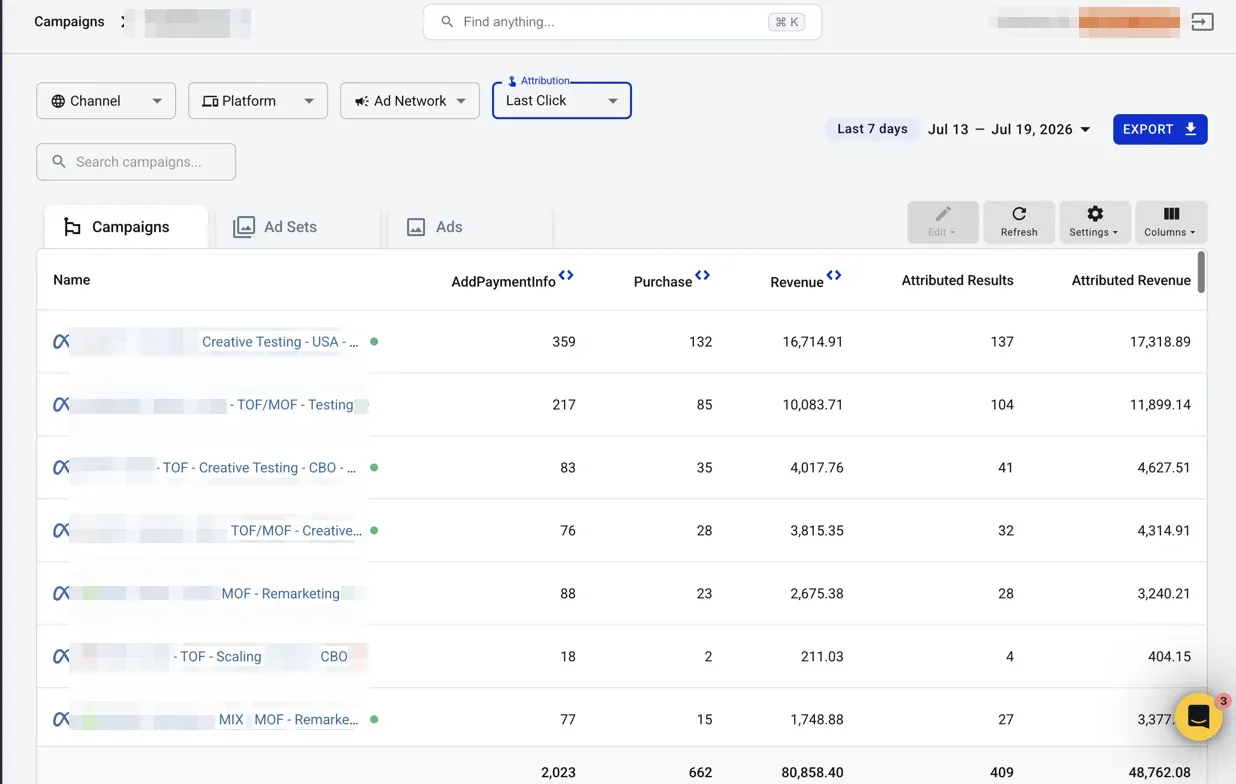
The same week under Last Click:
Row by row, top to bottom, here’s what switching the model did to purchases:
| Report row | Visible tag | Purchases: First Click | Purchases: Last Click | Shift |
|---|---|---|---|---|
| 1 | Creative Testing - USA | 109 | 132 | +21% |
| 2 | TOF/MOF - Testing | 121 | 85 | -30% |
| 3 | TOF - Creative Testing - CBO | 46 | 35 | -24% |
| 4 | TOF/MOF - Creative | 25 | 28 | +12% |
| 5 | MOF - Remarketing | 13 | 23 | +77% |
| 6 | TOF - Scaling | 6 | 2 | -67% |
| 7 | MIX - MOF - Remarketing | 6 | 15 | +150% |
Across the whole account, both views total the same: 662 purchases and just under $81K in revenue, and you can check it in the totals row of both screenshots. That’s the first thing to internalize. Switching models never creates or deletes a conversion. It moves credit between campaigns, and the totals prove it.
The Funnel Hand-Off, Quantified
Now read the shifts as roles.
The TOF campaigns gave up roughly 50 purchases under Last Click. Rows 2, 3, and 6 lose between 24% and 67% of their credited purchases the moment the model asks “who closed?” instead of “who opened?”. Those sales didn’t vanish. Most of them reappeared on the remarketing rows. That’s the funnel hand-off made visible: TOF introduced the buyer, remarketing closed them, and each model credits the stage it measures.
The remarketing campaigns doubled (or better) under Last Click. Rows 5 and 7 jump +77% and +150%. That gain is a dependency measure. The MIX - MOF campaign closes 15 purchases a week, but it started only 6 of those journeys. Cut the TOF campaigns that feed it and that audience pool drains.
One campaign broke its label. Row 1, the account’s biggest campaign, is tagged Creative Testing, and it gained +21% under Last Click. Testing campaigns are supposed to open journeys, not close them. When a testing campaign gains under Last Click, its delivery is reaching warm audiences in practice: overlapping the remarketing pools, or broad targeting drifting toward people who already clicked another ad. The model comparison audits your campaign naming for free.
The shift is proof of click order, and it shows in every column. A sale can only move from a TOF row under First Click to a remarketing row under Last Click if that buyer clicked the TOF ad first and the remarketing ad later. The comparison doesn’t guess your funnel; it measures the real click sequence. Check AddPaymentInfo in the screenshots: MOF - Remarketing goes from 45 to 88, MIX - MOF from 58 to 77, and the column total stays at 2,023 in both views. Same mechanism, every metric.
And the dependency is structural, not statistical. Remarketing campaigns spend against audiences built from site behavior: visitors who viewed products, added to cart, or reached payment. Those visitors were bought by the TOF campaigns. Pause TOF and the remarketing rows don’t just lose attribution credit; their audiences stop refilling.
Meta’s own columns flattered the closers even more. Attributed Results for the two remarketing rows came in at 28 and 27, above even the Last Click counts of 23 and 15 (you can see both columns side by side in the screenshots). That’s expected: ad platforms credit views as well as clicks (Meta’s default is 7-day click, 1-day view), and warm audiences rack up impressions. Those columns come from the ad platform and don’t move when you switch AnyTrack’s model, which makes them a useful third reference point, not a verdict.
That stability is what makes the comparison honest. Attributed Results are the platform’s attribution of the conversions AnyTrack sends it through the Conversion API. They hold still while you flip the AnyTrack model, so you’re comparing two AnyTrack lenses against one fixed platform number, for the same sales. In the screenshots, Meta lands between First Click and Last Click on the TOF rows (104 against 85 and 121) and above Last Click on the remarketing rows (28 against 23, 27 against 15), where view-through credit piles up. One warning: this comparison only stays honest while AnyTrack is the only system feeding your pixel and Conversion API. Add a second sender reporting the same sales and the platform can count them twice. When Attributed Results dwarf both AnyTrack views across the board, that’s the smell.
The Expensive Mistake
Most marketers run their entire account on a single last-click view. Here’s what that costs.
Judged on Last Click alone, row 6 (TOF - Scaling) is a disaster: 2 purchases for the week. Pause it, and its ~$640 of first-click revenue doesn’t move to another campaign. The buyers it was introducing simply stop entering the funnel, and a couple of weeks later the remarketing campaigns that looked brilliant have nobody left to close.
This isn’t an AnyTrack quirk; it’s an industry-wide measurement gap. Fospha measured last-click attribution undervaluing upper-funnel campaigns by an average of 14x (Fospha, 2025). That’s the industry. The fix on your side of the dashboard is simpler: judge each funnel stage with the model that matches its job.
- Read TOF campaigns under First Click. Their job is opening journeys.
- Read MOF and BOF campaigns under Last Click. Their job is closing them.
- Use the opposite view to see the dependencies before you touch budgets.
Run This on Your Account in Five Minutes
- Open the Campaign Report and set the date range to at least the last 7 days.
- Note purchases per campaign under Last Click.
- Switch the Attribution dropdown to First Click. The switch is a view toggle: it works on every plan and changes nothing about your tracking or the conversion signals AnyTrack sends to ad platforms.
- Compare campaign by campaign. The totals should hold; the distribution shouldn’t.
- Read the roles. Gains under First Click: opener. Gains under Last Click: closer. Barely moves: the only ad its buyers ever clicked.
If a campaign shows nothing under either model, check its UTM template first. No UTMs on the click means no campaign attribution, under any model.
Stop Paying for the Wrong Verdict
Every week you judge the whole account on one model is a week of budget drifting toward the campaigns that take credit and away from the campaigns that create customers. The data to see the difference is already in your Campaign Report: one dropdown, two questions, and a much better answer to “which campaigns actually make money?”
Start your free AnyTrack trial and see your own funnel under both lenses.

Laurent Malka is the Co-Founder of Anytrack. He was born and raised in Switzerland, and now lives and works in Israel. He is a serial entrepreneur with over 15 years of experience in marketing and business development. Laurent has been a panelist and speaker at numerous digital marketing events including SEMrush and IG Affiliates. He prides himself on his ability to connect the dots across disciplines, industries, and technologies to solve unique challenges.