


Meta Ads Automation Rules: 5 That Actually Work [2026]
On this page
Meta Ads automation rules are if-then triggers inside Ads Manager that pause, scale, alert, or adjust campaigns based on the thresholds you set. Used right, they save 10 to 20 hours a week and stop lazy spend before it compounds.
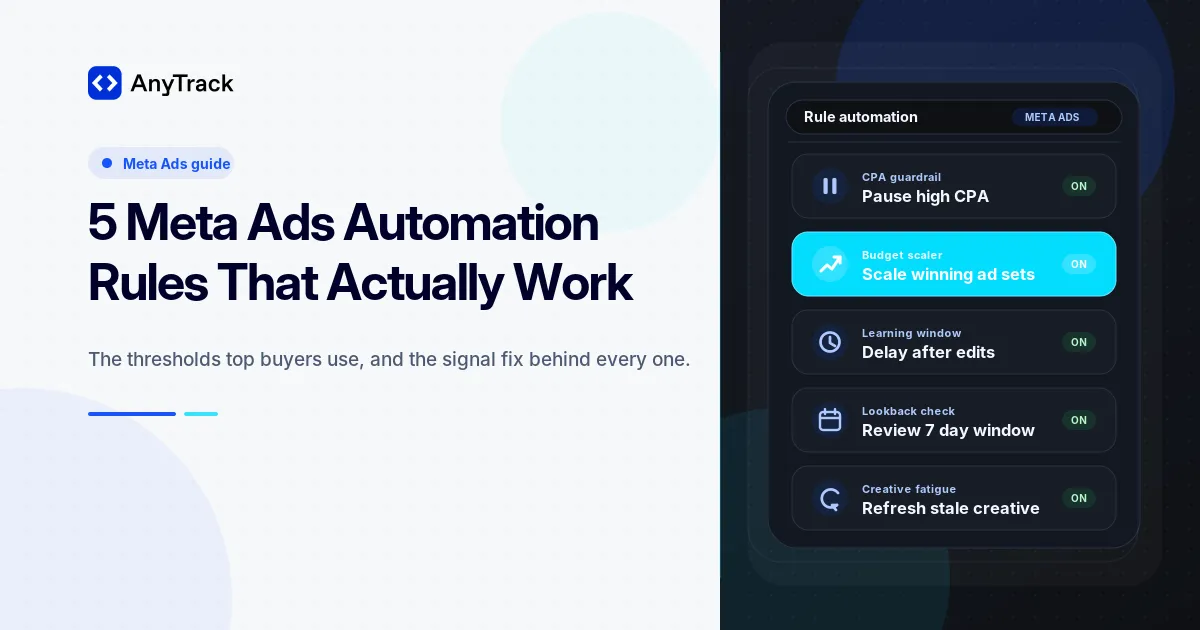
Five rules do 80% of the work: pause underperformers, scale winners, adjust bids by time of day, shift weekend budgets, and kill fatigued creative. The exact thresholds are in the table below.
One catch worth flagging before you set anything up: automation rules only work as well as the conversion data they read. Meta has been missing 20 to 30% of real conversions since iOS 14.5, and a ROAS-based pause rule using Meta-only numbers will routinely kill profitable ad sets. We’ll cover the signal fix at the end.
| # | Rule | When it fires | Action | Recommended threshold |
|---|---|---|---|---|
| 1 | Pause underperformer | Spend at 2x target CPA with 0 conversions | Pause ad set | 3-day lookback |
| 2 | Scale winner | ROAS at or above 1.3x target for 3 days | Increase budget 20% | Cap at +50% per week |
| 3 | Dayparting | CPA in low-converting hours is 1.5x average | Lower bid 30% | Per-account hour bucket |
| 4 | Weekend shift | CPM drops 15% Saturday and Sunday | Raise budget 15% Sat/Sun | Reset Monday |
| 5 | Creative fatigue kill | Frequency above 3.5 and CTR drop above 25% | Pause ad | 7-day lookback |
What Meta Ads automation rules actually do
Meta’s automated rules system monitors your campaigns continuously and takes specific actions when conditions you define are met. Think of them as if-then statements for your ad spend:
- Protect your budget: Automatically pause ads when cost per acquisition exceeds your threshold after minimum spend.
- Scale winners: Increase budgets by 20% when ROAS surpasses your target for 3+ days.
- Time-based optimization: Adjust bids based on dayparting data (higher during peak conversion hours).
- Creative fatigue prevention: Pause ads when frequency climbs too high or CTR drops below benchmarks.
- Platform optimization: Use Meta’s Value Rules to adjust bids by placement, age, gender, location, or device.
Meta’s automation landscape: Advantage+, Value Rules, Incremental Attribution
Meta has been pushing harder toward automation with Advantage+ campaigns, which strongly encourage rigid settings and “keeping Advantage+ on.” This shift means less manual control, making the rules you do set even more critical.
Recent platform changes worth knowing:
- Value Rules (launched June 2025): Adjust bids for specific audience segments, though Meta warns costs may increase 20% to 1,000% if used incorrectly.
- Incremental Attribution (April 2025): New metric showing true ad lift, reporting 20%+ improvement in measuring real conversion impact.
- First Conversion vs. All Conversions: Critical for lead gen and SaaS to avoid counting duplicate conversions from the same user.
The 5 essential Meta Ads automation rules every advertiser needs
1. Budget protection: pause underperformers before they drain cash
Rule setup:
- IF Cost Per Result > $X (your max CPA threshold)
- AND Amount Spent > $Y (minimum test budget, e.g., $50 to $100)
- AND Ad Set is NOT in learning phase
- THEN Pause Ad Set
Why this works: It’s okay to spend some amount testing creative performance. But you want to stop before ads drain your budget on proven losers. This rule gives ads breathing room to exit the learning phase, then kills them if they don’t perform.
Real example: Set cost per purchase > $75, amount spent > $100, campaign not in learning, pause. This prevents runaway spending while allowing sufficient data collection.
2. Winner scaling: increase budget on high performers
Rule setup:
- IF ROAS > [your target, e.g., 3.0]
- AND Results > 10 (or another minimum conversion threshold)
- THEN Increase Daily Budget by 20%
- Frequency: Check daily, pulling from 3-day lookback window
Critical nuance: Never increase budgets by more than 30% at a time. Larger jumps reset Meta’s algorithm back into learning phase, tanking performance. Gradual 10% to 20% increases compound better than aggressive jumps.
Advanced version: Layer in creative freshness by only scaling if ad frequency is below 2.5 and CTR is above your baseline. This prevents you from pouring budget into fatigued creative.
3. Dayparting optimization: adjust bids by time of day
Rule setup:
- IF Time is 5 PM to 9 PM (peak conversion hours based on your data)
- THEN Increase Manual Bid by 20%
- Custom schedule: Only on weekdays
Why this matters: If you know your best customers convert during specific hours, automated dayparting ensures you’re bidding aggressively when it matters. The inverse rule decreases bids during low-converting hours.
Caveat: This only works with lifetime budgets, not daily budgets. Meta’s algorithm uses lifetime budgets to distribute spend more intelligently across scheduled hours.
4. Weekend budget adjustment
Rule setup:
- IF Day is Saturday OR Sunday
- AND Historical weekend ROAS < weekday ROAS by 20%+
- THEN Decrease Daily Budget by 30%
The data behind it: Many B2B and lead gen campaigns see dramatically lower weekend performance. Rather than pause entirely (losing remarketing opportunities), reduce spend proportionally.
5. Creative fatigue kill switch
Rule setup:
- IF Ad Frequency > 3.0
- AND CTR < 0.9% (adjust based on your benchmarks)
- THEN Send Notification AND Pause Ad
Why notifications matter: This rule alerts you to rotate in fresh creative. Automation can pause the fatigued ad, but you still need human judgment to launch new angles.
Advanced automation strategy: the hybrid scaling approach
Top agencies don’t choose between manual and automated. They use both strategically.
Vertical scaling (automation): Increase budgets gradually on proven winners using automated rules.
Horizontal scaling (manual): Launch new audiences (2 to 3 lookalikes weekly) and test new creative angles (3 to 5 variations every 10 to 14 days).
AI-assisted optimization: Use automated rules to track signals (ROAS spikes, CPM increases, fatigue frequency) and trigger adjustments.
This layered approach balances machine precision with human creativity, driving sustainable, compounding growth.
The problem: your automation is only as good as your data
Here’s where most advertisers hit a wall.
Let’s say you set up the perfect automation rule: “Increase budget by 20% if ROAS > 3.0 over 3 days.” Smart, conservative, proven strategy.
But what if Meta Ads Manager shows 3.2x ROAS, and your actual ROAS is 4.8x?
This isn’t theoretical. It happens constantly.
The attribution accuracy crisis
Since iOS 14.5, Meta’s ability to track conversions has been severely compromised:
- 84% of iOS users opt out of tracking
- Attribution windows shrunk by 75%
- 20-30% of conversions go unattributed or estimated
- Meta Pixel alone misses browser-based conversions blocked by privacy settings
Meta’s default attribution (7-day click / 1-day view) shows correlation, not causation. It’s blind to:
- Longer customer journeys (default 7-day window misses multi-week consideration).
- Cross-device behavior (user clicks on mobile, converts on desktop days later).
- Organic search traffic triggered by ads.
- Users who would have converted anyway (no incrementality measurement).
Real-world impact: the data discrepancy
Case study: A home décor brand thought their Meta campaign had a 2.6x ROAS according to Ads Manager. When they synced server-side conversions with proper attribution, the true ROAS was 4.1x.
Instead of cutting the budget (which automation rules would have suggested), they scaled and doubled revenue within 3 weeks.
That’s the power of scaling with real data.
Why this breaks automation
When your tracking is off by 20% to 30%, your automation rules make the wrong decisions:
- You pause winning campaigns because reported ROAS looks weak.
- You under-invest in high performers because Meta can’t see the full conversion picture.
- You scale the wrong creative because attribution data is skewed.
- You optimize for volume instead of value because profit data isn’t flowing back.
Research shows roughly 20% to 25% of conversions in typical lead gen campaigns come from repeat actions, not new customers. If you’re using “All Conversions” instead of “First Conversion” reporting, your CAC is wrong by 33%.
You’re not running bad automation rules. You’re running good rules on bad data.
How AnyTrack closes the gap
Fixing this needs three things working together: server-side tracking that survives browser restrictions, cross-platform attribution that follows the customer across devices, and first-party signals flowing back into Meta so the bidding algorithm sees real revenue.
AnyTrack is built for exactly this problem. It sits between your sales stack (Shopify, ClickFunnels, HubSpot, affiliate networks) and your ad stack (Meta, Google, TikTok) and orchestrates the data flow automatically.
Server-Side Tagging that survives browser restrictions: AnyTrack collects conversion events server-side and sends them to Meta via Conversion API, bypassing the privacy blocks that break traditional tracking.
Cross-domain and cross-platform attribution: Track the full customer journey even when users hop between domains or devices. See which Meta ad actually drove the sale, even when the conversion lands days later somewhere else.
No-code setup: Live in minutes, not weeks. No engineering team required.
With accurate data flowing in, your automation rules fire on real numbers:
- Budget scaling triggers on true high performers, not false negatives.
- Pause rules protect against actual losers, not missing attribution data.
- ROAS targets align with what your bank account actually shows.
Advertisers using server-side tracking see up to 19% additional purchase attribution compared to Pixel-only setups. That’s 19% more visibility into sales that were already happening. If you sell on Shopify, the playbook to send Shopify purchases to the Meta Conversions API walks through that exact setup, deduplication included.
Setting up automation rules the right way
Step 1: audit your tracking setup
Before creating any automation rules, verify:
- Meta Pixel is firing correctly on all key pages (product views, add to cart, purchase).
- Conversion API is sending server-side data, not just Pixel.
- Event matching is configured to prevent duplicate attribution.
- Test data quality using Meta’s Events Manager diagnostics.
- Compare Meta’s reported conversions with your actual sales data.
If there’s more than a 10% to 15% discrepancy, fix tracking first. Automation on bad data makes things worse, not better.
Step 2: establish your performance baselines
Pull 30 to 90 days of historical data and calculate:
- Average ROAS by campaign type.
- Median cost per acquisition.
- CTR benchmarks by placement and creative format.
- Frequency thresholds where performance drops.
- Learning phase duration for your account.
Your automation rules should be based on your data, not industry averages. A 2.5x ROAS might be amazing for one business and terrible for another.
Step 3: create your first rules (conservative start)
Navigate to Meta Ads Manager → Rules → Create a New Rule.
Rule 1, budget protection:
- Apply to: All Active Ad Sets
- Action: Turn Off
- Conditions: Cost Per Purchase > [1.5x your target CPA] AND Amount Spent > $100 AND Not in Learning Phase
- Schedule: Run continuously, check every 6 hours
- Notification: Email when rule takes action
Rule 2, winner scaling:
- Apply to: All Active Ad Sets
- Action: Increase Daily Budget by 15%
- Conditions: ROAS (7-day click) > [1.2x your target] AND Results > 15 AND Frequency < 2.5
- Attribution: Pull from 3-day lookback
- Schedule: Run daily at 9 AM
Pro tip: Start with preview mode for 48 hours. This shows what the rule would do without actually making changes. Monitor daily during the first week, then weekly after that.
Step 4: layer in incremental attribution
Meta’s Incremental Attribution provides a more accurate view of ad effectiveness. Enable it in Ads Manager to see:
- Which conversions can be directly linked to ad exposure.
- True incremental lift vs. conversions that would have happened anyway.
- More realistic ROAS figures (often lower, but more accurate).
Use Incremental Attribution for strategic decisions and traditional attribution for day-to-day optimization. The combination gives you both operational efficiency and strategic clarity.
Step 5: monitor and refine
Automation doesn’t mean “set it and forget it.” Review weekly:
- How often are rules triggering?
- Are paused campaigns actually underperforming, or is attribution delayed?
- Are scaled campaigns maintaining ROAS, or degrading after increases?
- Do you need to adjust thresholds based on seasonal patterns?
Keep a log of rule changes and performance impact. What works in Q1 may need adjustment in Q4.
Common automation mistakes (and how to avoid them)
Mistake 1: setting thresholds too tight
What happens: Your rules pause campaigns during normal ROAS fluctuations, killing momentum before algorithms can optimize.
Fix: Base thresholds on 3 to 7 day averages, not daily snapshots. Allow 20% to 30% variance before triggering pause rules.
Mistake 2: ignoring learning phase
What happens: Rules fire during learning phase when performance is naturally volatile, preventing campaigns from stabilizing.
Fix: Add “Campaign is NOT in learning phase” as a condition for all budget adjustment rules. Let campaigns collect 50+ conversions per week before automation kicks in.
Mistake 3: scaling too aggressively
What happens: Budget increases above 30% trigger learning phase resets, tanking performance even on winners.
Fix: Cap increases at 20% per adjustment. Set rules to run daily or every other day, not continuously. Compounding gradual growth beats aggressive jumps.
Mistake 4: not accounting for attribution delays
What happens: You pause campaigns that look weak on day 1 to 2, but conversions from delayed attribution (especially with 7-day windows) would have justified the spend.
Fix: Use 3 to 7 day lookback windows. Don’t make pause decisions based on same-day data alone.
Mistake 5: treating all conversions equally
What happens: For lead gen and SaaS, “All Conversions” counts duplicate submissions from the same user, inflating results and misleading automation rules.
Fix: Use “First Conversion” reporting for new customer acquisition campaigns. Reserve “All Conversions” for total revenue tracking and retargeting.
Frequently asked questions about Meta Ads automation rules
Will automation rules reset the Meta Ads learning phase?
No. Budget-change rules that adjust by 20% or less, and rules that pause or duplicate ad sets, don’t kick a campaign out of the learning phase. What does reset learning: editing the optimization event, changing the audience, swapping placements, or changing the bid strategy. Stick to budget tweaks and pause actions in your automation and learning stays intact.
Does domain verification break automation rules or active campaigns?
Domain verification itself doesn’t reset learning or pause your ads. What it does do: change the data flowing into your rules. Once verified, Meta enables Aggregated Event Measurement, prioritized events, and shifted attribution windows, all of which can move your reported ROAS and CPA. Re-baseline your thresholds for 7 to 14 days after verifying so your rules aren’t acting on pre-verification numbers.
What’s the minimum daily budget per ad set for Meta Ads automation in 2026?
Enough to hit the learning phase target of roughly 50 optimization events per 7 days. For most US accounts that means $20 to $50 per day per ad set for purchase events, $10 to $20 for lead events, and $5 to $10 for engagement events. Local markets and high-CPA verticals will need more. The honest rule: if you can’t generate 50 events in a week, your rules won’t have enough data to act on confidently.
When should I use Advantage+ campaigns vs. manual automation rules?
Advantage+ is Meta running the optimization for you across creative, audience, and placement. Manual automation rules are you defining the if-then logic explicitly. Use Advantage+ when you have a proven offer, clean conversion data, and enough budget to give the algorithm room (typically $100+ per day). Use manual rules when you need guardrails (budget caps, frequency caps, dayparting), when you’re testing a new audience or creative angle, or when your account history is too thin for Advantage+ to learn from.
How do I align Meta Ads delivery with conversion time windows using automation?
If your customers convert in narrow time windows (most B2B leads close 9 to 5 weekdays, most DTC purchases happen evenings), use dayparting rules on lifetime budgets to push spend into those hours. Pair it with a frequency cap rule that pauses delivery once an ad set hits 3 impressions per user inside a 24-hour window. The combination concentrates spend on high-intent moments instead of spreading thin across low-converting hours.
Key takeaways
Automation rules save 10 to 20 hours weekly and improve performance, but only with accurate data feeding them.
The five essential automation rules every advertiser needs:
- Budget protection (pause underperformers).
- Winner scaling (increase budgets on high ROAS).
- Dayparting optimization (bid adjustments by time).
- Weekend budget adjustment (reduce spend during low-converting periods).
- Creative fatigue kill switch (pause when frequency or CTR degrade).
20% to 30% attribution loss is standard since iOS 14.5. If your automation decisions are based on incomplete data, you’re pausing winners and under-investing in high performers.
Server-side tracking is non-negotiable for accurate attribution. Pixel-only setups miss conversions that browser restrictions block. Combining Pixel and Conversion API delivers up to 19% additional purchase attribution visibility.
Start conservative, then scale. Use preview mode for new rules. Base thresholds on your data, not industry benchmarks. Avoid triggering rules during learning phase. Cap budget increases at 20% to prevent algorithm resets.
Automation enhances human strategy; it doesn’t replace it. Use rules for repetitive optimization tasks. Reserve creative decisions, audience testing, and strategic pivots for human judgment.
Ready to stop guessing and start scaling?
Automation only works when it’s built on truth. And the truth is in your data, if you can see all of it.
AnyTrack eliminates the attribution gap between what Meta reports and what’s actually happening. Automatic server-side tracking. Cross-platform attribution. Real revenue data flowing to Meta for better optimization. No engineering team required.
If you’re running Meta Ads automation rules right now, ask yourself: Am I optimizing for what’s real, or what’s visible?
Because the difference between those two numbers is the difference between profitable scaling and burning cash in your sleep.

Laurent Malka is the Co-Founder of Anytrack. He was born and raised in Switzerland, and now lives and works in Israel. He is a serial entrepreneur with over 15 years of experience in marketing and business development. Laurent has been a panelist and speaker at numerous digital marketing events including SEMrush and IG Affiliates. He prides himself on his ability to connect the dots across disciplines, industries, and technologies to solve unique challenges.
Related posts
 Laurent Malka
 Event Match Quality Explained
 Laurent Malka