


Mobile Is Now the Majority of Your Traffic. Your Tracking Doesn't Know It.
Mobile took 52.57% of global web traffic in July 2026. Desktop took 45.93%, tablets the remaining 1.5% (Statcounter, July 2026).
That crossover isn’t news. What’s worth your attention is the second-order effect: the majority of your traffic now arrives on the device where browser-based conversion tracking is weakest, and most measurement setups were designed when the majority arrived on the device where it worked fine.
The gap between those two facts is where your missing conversions live. It shows up differently depending on what you run. If you’re on Shopify it’s the gap between what Meta reports and what your checkout actually recorded. If you run affiliate offers it’s commissions that die somewhere in the redirect chain. If you run lead gen it’s a close that happens in your CRM days later, on a different device than the one that saw the ad. Each section below holds for all of them; the last one gets specific.
ATT Is Real, and It Is Not Yours to Fix
Start here, because this one costs people real money in strategy meetings.
When mobile measurement comes up, someone reliably cites an App Tracking Transparency opt-in rate. The usual conclusion follows: a minority of iOS users agree to be tracked, therefore most of your mobile conversions are invisible, therefore you should do something about ATT.
The first half is true. The last step is where it goes wrong, and the reason is worth understanding properly.
ATT binds app publishers, not websites. Apple’s own definition: tracking is “the act of linking user or device data collected from your app with user or device data collected from other companies’ apps, websites, or offline properties for targeted advertising or advertising measurement purposes.” The obligation attaches to whoever ships the app. Miss it and the app comes off the App Store, which is why compliance isn’t optional for anyone with something to lose.
Meta ships a lot of apps, and they show ads. Facebook, Instagram, and Messenger are where an enormous share of your paid mobile traffic originates. When someone taps your ad inside one of those apps, Meta knows exactly who they are. What ATT governs is whether Meta may carry that in-app identity across to what the person then does on your website, which is precisely the linkage in Apple’s definition.
So ATT does affect your web conversions. It just isn’t a setting you own.
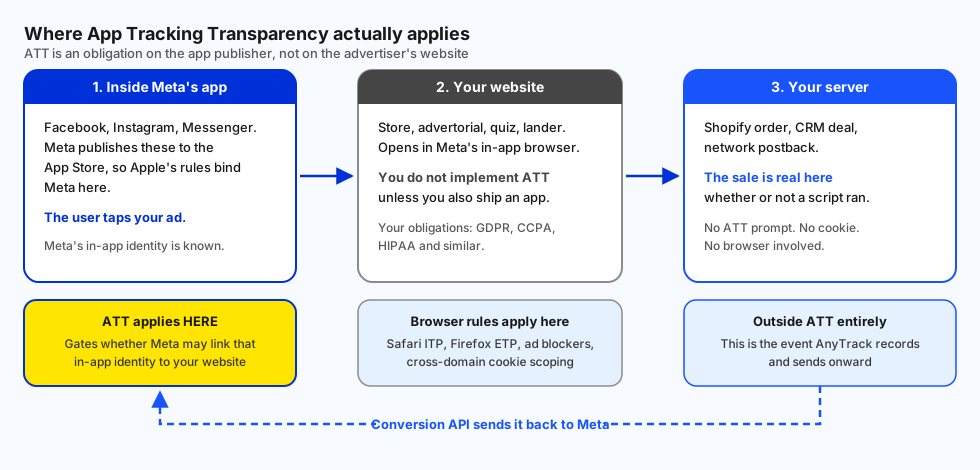
What actually happens when someone taps your ad
The detail that makes this concrete: Meta doesn’t hand the user to Safari. Tapping an ad inside Facebook or Instagram opens your site in Meta’s own in-app browser, a web view living inside the app. The whole journey stays on Meta’s turf, which is why the app rules reach into it.
Before ATT, that arrangement was ideal for Meta. The Pixel on your site matched the web session to the Meta identity that had just tapped the ad, and a purchase came back as a specific person buying a specific thing.
For a user who chose “Ask App Not to Track”, that link is severed. The Pixel still fires, but it can’t return individually identifiable data tying the sale to that person’s Meta profile. Three things follow, and they’re what you actually see in your account:
- Aggregated instead of individual. Opted-out iOS web conversions come back through Aggregated Event Measurement, which reports in aggregate rather than per person. (If you’ve read older guides telling you to rank your 8 priority events, that system is gone. Meta removed the event cap and manual prioritization in June 2025 and now aggregates eligible events automatically. AEM itself is still very much in force.)
- Delayed instead of real-time. Those conversions can take up to 72 hours to surface, so the campaign you judged this morning may not have reported yet.
- Missing instead of late. Sometimes the sale simply never appears. Your Shopify backend shows the order and Ads Manager shows nothing, which is the single most common reason people conclude their tracking is broken.
Your compliance surface is different. If you publish an app on the App Store, you implement ATT. If you run a website, ATT is not a thing you configure at all. What binds you is GDPR, CCPA, HIPAA, and whatever else your jurisdiction and vertical impose. Two separate regimes that people merge constantly because both get filed under “privacy killed my tracking.”
Meta’s own answer was to stop relying on the browser
Here’s the part worth sitting with. Faced with this, Meta didn’t try to fix browser tracking. It moved the industry off it.
ATT governs what apps and browsers may do on a person’s device. It has no reach into a business’s own server. So the route Meta now recommends skips the browser entirely:
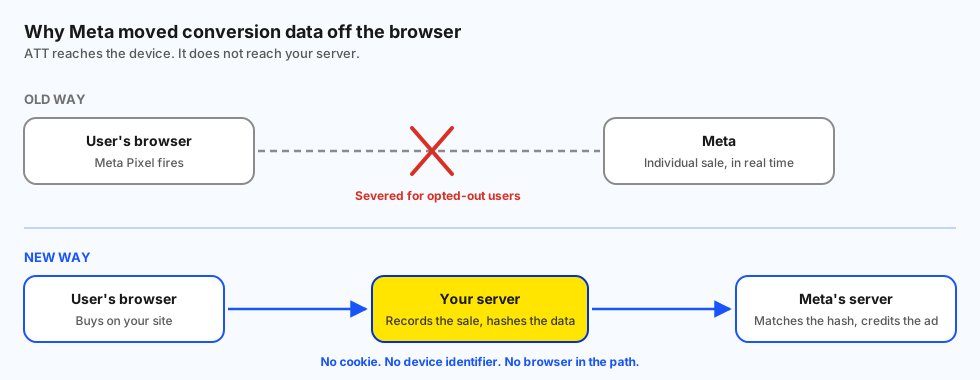
Your server already knows the sale happened. It packages the customer details it legitimately holds, hashed before they leave, and sends them to Meta’s server. Meta matches the hash against its own records and credits the ad. No cookie, no device identifier, no in-app browser in the path.
That’s the Conversion API, and it exists because of everything above.
Which reframes the whole exercise. Server-side conversion tracking isn’t a clever workaround that skirts the platforms. It’s the direction the largest ad platform on earth publicly moved to when its browser-side route stopped working. The open question was never whether to do it, only whether you’d wire it up yourself.
Three consequences, all practical:
- The opt-in rate is not an input you can act on. It describes a constraint on Meta’s side of the wire. Tracking it as a KPI tells you nothing you can change.
- Don’t benchmark web measurement against app-attribution numbers. Those figures come from AppsFlyer, Adjust, and Singular, measuring app installs. Different category, different problem, and being precise about it is competitive advantage when the person across the table isn’t.
- The fix is on your side of the wire. If Meta’s browser-side view of the journey is degraded by something you don’t control, stop depending on it. Record the conversion where it actually happens, on your own server, and send it to Meta yourself.
That third point is the whole argument of this post, and ATT is the clearest illustration of it. You cannot make Meta’s in-app identity linking work again. You can make the sale itself observable in a way that never depended on it.
Roughly Three in Ten Visitors Block Your Pixel Before It Fires
29.5% of internet users worldwide run an ad blocker. In the US it’s 32.5% (GWI/DataReportal, Q2 2025).
Note what this is not. It isn’t the share of conversions you lose, and anyone quoting it that way is doing arithmetic the data doesn’t support. It’s the share of people for whom a browser-side script may never execute at all.
The distinction matters because of who those people are. Ad-blocker adoption skews toward younger, more technical, higher-income users. If that describes a slice of your buyers, you’re not losing a random sample of conversions. You’re losing a biased one, and your ad platform’s algorithm is learning from whoever’s left.
That’s the part that compounds. A random 30% loss makes your reporting noisier. A systematic 30% loss teaches the bidding algorithm that a segment which actually converts doesn’t, and it bids accordingly.
Last Click Undervalues Your Upper Funnel by 14x
Last-click attribution undervalues YouTube and Demand Gen campaigns by an average of 14x (Fospha, 2025).
Mobile makes this worse rather than better. Mobile journeys fragment: the discovery tap happens on a phone during a commute, the considered purchase happens on a laptop that evening. Last click sees the laptop and credits the laptop. The phone tap that started it gets nothing.
Scale that across a quarter and you’ll systematically defund the campaigns doing the introducing, which is a mistake that looks like discipline on a dashboard.
Between 40% and 60% of Conversions Land Outside the Window
Between 40% and 60% of demand-gen conversions happen outside the standard 30-day attribution window (Google Internal Data, 2025).
A 30-day window is a measurement convenience, not a description of how people buy. Considered purchases, B2B pipelines, and high-ticket eCommerce routinely run longer, and mobile discovery tends to sit at the front of exactly those long journeys.
If half your conversions resolve after the window closes, half your conversions are attributed to nothing at all.
What Actually Recovers the Signal
Two numbers on the other side of the ledger.
Server-side tagging recovers roughly an 11% uplift in conversion signals compared with client-side tracking alone (Google Data, 2025). And marketers with a first-party data strategy are 1.5x more likely to outperform their competitors (Google/Kantar, 2024).
Neither is a product claim. They’re the industry’s own read on where measurement is heading, and the direction is consistent: move collection off the browser, and own the data before you send it anywhere.
Here’s the mechanical reason that works on mobile specifically. A conversion that happens on a server is not subject to what the visitor’s browser permits. A Shopify order exists whether or not a script ran. A network postback exists whether or not the redirect preserved a cookie. A closed deal in your CRM exists whether or not the session survived. The event is real; the only question is whether your measurement can reach it.
For anyone reporting a number upward, the chain matters more than the statistic: conversions recorded at the source are real conversions, real conversions sent through each platform’s Conversion API give the bidding algorithm something true to learn from, and an algorithm learning from actual sales rather than proxy events is what moves CPA in the direction you want. That’s also the version of the number you can defend when someone asks why it doesn’t match the ad platform’s dashboard.
The dedup question comes up immediately here, and it should. If the browser event and the server event both describe one sale, you don’t want the platform counting two. AnyTrack deduplicates the two before delivery so the conversion counts once on each platform.
Where This Leaves Your Setup
| What you’re measuring | What mobile does to it | What holds up |
|---|---|---|
| Browser pixel on a thank-you page | May never fire for roughly 3 in 10 visitors | Server-side collection from the source system |
| Cookie-based session continuity | Breaks on the hop to another domain, whether that’s a checkout, a cart subdomain, or a network redirect | First-party identifiers passed across the hop |
| Last-click attribution | Credits the closing device, not the discovering one | Click-based attribution with a selectable model |
| 30-day window | Closes before 40-60% of conversions resolve | Windows matched to your actual sales cycle |
AnyTrack is built for that column on the right. The Tracking Tag collects first-party click and session data on your own domain, server-side integrations record conversions from Shopify, your CRM, and your affiliate networks where they actually happen, and the resulting conversions are sent to Meta, Google, TikTok, and Microsoft through each platform’s Conversion API. Attribution runs on an identifiable ad click, and you choose whether the first or the last one gets the credit.
What that looks like in your stack
Running a Shopify or WooCommerce store. The order exists in your backend whether or not the browser cooperated, so the order is what gets recorded and sent, which is why the number stops drifting from what Meta reports.
Running affiliate offers. You don’t own the merchant’s site and can’t put a tag on it, so the conversion comes back the other way: the network’s postback returns the click ID and payout, and that’s what ties the commission to the ad click that earned it, across every network in one place instead of one dashboard at a time.
Running lead gen. The close happens on a call or in the CRM days after the tap. Server-side CRM events carry that closed deal, and its value, back to the ad platform and attach it to the original click, so you’re optimizing toward leads that actually close rather than form fills.
Running client accounts. Each client gets its own property with its own integrations and its own ad accounts, kept separate, which is what makes a per-client number defensible on a Monday call instead of an argument about whose dashboard is right.
The mobile majority isn’t a future problem to plan for. It arrived, and the measurement setups that assume otherwise are already reporting numbers that don’t reconcile.
Start tracking free and see which of your mobile conversions your ad platforms have never been shown.
Sources
- Apple, App Store user privacy and data use, definition of tracking and the ATT requirement
- Meta Business Help Center, Aggregated Event Measurement, including the June 2025 removal of the event cap and manual prioritization
- Statcounter Global Stats, Desktop vs Mobile vs Tablet Market Share Worldwide, July 2026
- GWI / DataReportal, ad-blocker usage, Q2 2025
- Fospha, last-click undervaluation of YouTube and Demand Gen, 2025
- Google Internal Data, conversions outside the 30-day window, 2025
- Google Data, server-side tagging conversion-signal uplift, 2025
- Google / Kantar, first-party data strategy and competitive outperformance, 2024

Laurent Malka is the Co-Founder of Anytrack. He was born and raised in Switzerland, and now lives and works in Israel. He is a serial entrepreneur with over 15 years of experience in marketing and business development. Laurent has been a panelist and speaker at numerous digital marketing events including SEMrush and IG Affiliates. He prides himself on his ability to connect the dots across disciplines, industries, and technologies to solve unique challenges.