


RedTrack vs Voluum for ClickBank Affiliates: The Ad Blocker Problem

On this page
You run Facebook and Google Ads to a bridge page. The bridge page sends buyers to a ClickBank offer. You want every sale back in Meta and Google so their bidding learns who buys. So you ask the usual question: RedTrack or Voluum?
Most comparisons answer with feature lists: campaign caps, Conversion API support, automation rules, price tiers. They miss the one detail that costs you sales, not just data.
On Facebook and Google Ads, RedTrack and Voluum both put the tracker’s click URL on your CTA, and a script on the page has to load before that URL can reach the offer.
When an ad blocker stops that script, the CTA leads to an error page. The visitor was ready to buy. You paid for the click. ClickBank never sees them.
The Short Answer
- For Facebook and Google Ads to ClickBank, pick a tracker that keeps the real ClickBank hop link on your page. If the tracker fails, the buyer still reaches the offer. That is how AnyTrack works.
- Pick RedTrack if you buy across many traffic sources and need rules-based automation, plus traffic distribution on redirect sources, and you accept the ad-blocker exposure on Meta and Google.
- Pick Voluum if you run native, pop, or push traffic, where redirect tracking, lander rotation, and bot filtering matter most.
The two-minute test near the end confirms it on your own funnel.
How RedTrack and Voluum Track on Facebook and Google
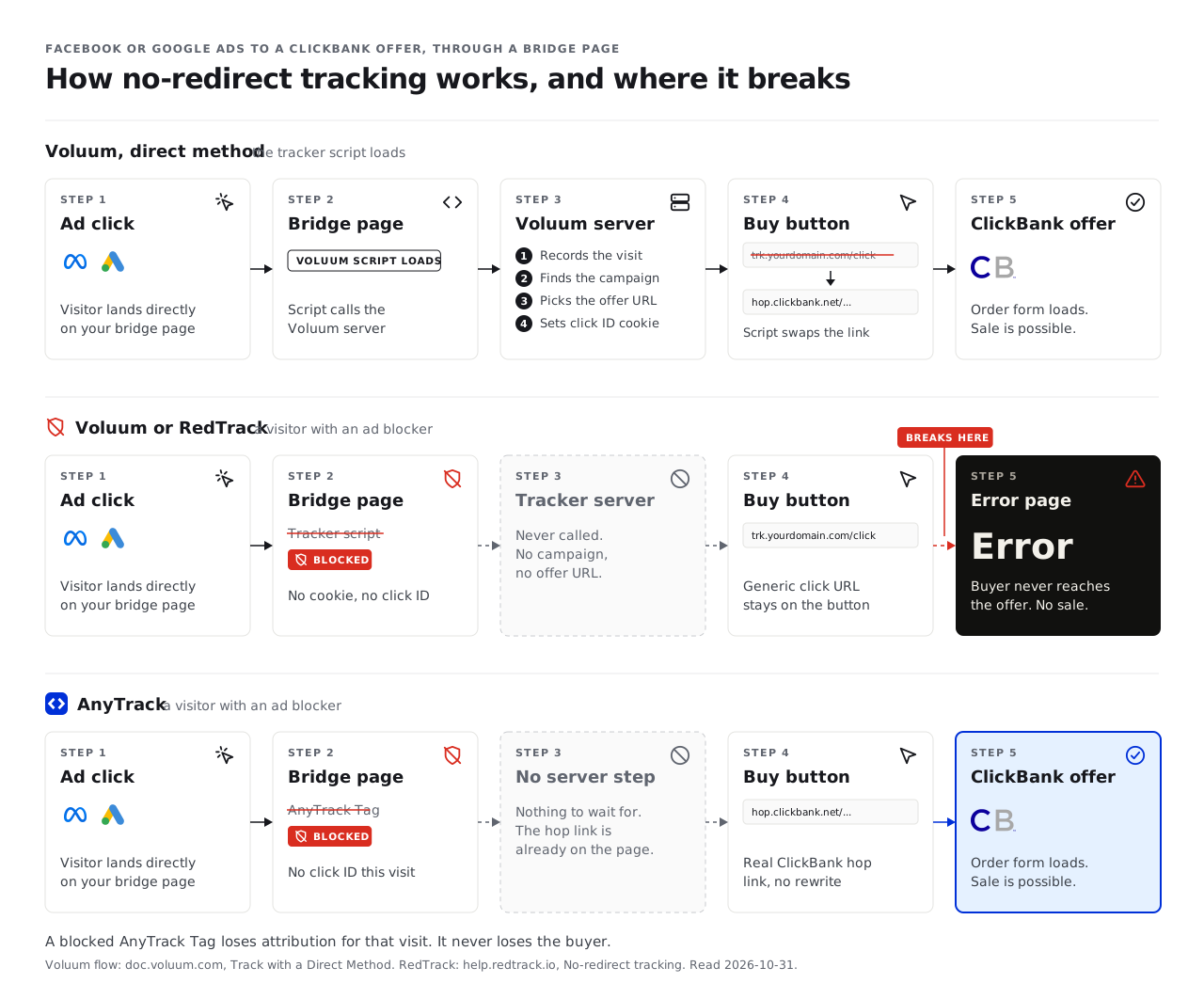
Both tools offer redirect tracking. The ad sends the visitor to a tracking URL on your tracking domain. The tracker records the click and redirects to the landing page or the offer.
Meta and Google don’t like that. RedTrack’s own help center says its no-redirect method is “the only one accepted by such giants as Meta, Google, and Bing.”
Voluum’s documentation names its direct method as the compliant choice for traffic sources that don’t allow rotating destinations, with Meta Ads as the example.
So on the two platforms you buy, both tools switch to a no-redirect setup. It works in three steps:
- The ad sends the visitor straight to your landing page. No redirect on the ad click.
- A tracker script on the page records the visit. It stores the click ID in the browser: a first-party cookie for RedTrack, cookies and local storage for Voluum.
- Your CTA button carries a generic click URL, such as
https://trk.yourdomain.com/click. It holds no campaign ID and no click ID. The tracker needs the stored click ID to know where to send the visitor.
RedTrack calls that CTA click URL “obligatory for all campaigns with landing pages.” Voluum’s direct-method doc says its script “replaces a click URL with a destination URL” on page load. In both tools, the path from your button to the ClickBank offer depends on the script.
What happens when that click URL arrives with no click ID? RedTrack’s Fallback URL doc names filters and caps as its cases, not this one. Its FAQ lists a no-redirect script that fails to load as a cause of the “empty clickid value” error.
Voluum’s FAQ lists a click URL opened without its campaign URL as a cause of error 400.
What Happens When the Visitor Runs an Ad Blocker
Ad blockers stop tracking scripts. That is their job. And they are not a niche:
- 1.1 billion people used an ad blocker in Q4 2025, about 30% of internet users worldwide (eyeo Ad-blocking Report 2026).
- 629 million of them block on mobile and 448 million on desktop, so blocking is not only a desktop habit anymore (same report).
- In the markets ClickBank affiliates buy most, the 2025 block rate per country is 33% in the US, 33% in Canada, 29% in Australia, and 27% in the UK (GWI data in the same report).
- Many of these tools block “ad and analytics trackers” as well as ads, eyeo notes. A tracker script is exactly that.
Here is the same visit with an ad blocker installed:
| Step | Without an ad blocker | With an ad blocker |
|---|---|---|
| Ad click | ✓ Bridge page loads | ✓ Bridge page loads |
| Tracker script | ✓ Loads, stores the click ID | ✗ Blocked, no click ID stored |
| CTA link | ✓ ClickBank offer | ✗ Generic /click URL |
| CTA click | ✓ Order form | ✗ Error page |
| Result | ✓ Sale, commission, conversion sent to Meta and Google | ✗ No sale, no commission, paid click wasted |

Example error page, from our earlier post on disabled Facebook ad accounts.
RedTrack’s docs point both ways, so here are both. Its landing page guide says clicks and landing page views should ideally be equal, and the first reason it lists for a gap is “a lot of people are using antiviruses and adblockers.”
Its FAQ says ad blockers do not block its script, because the script runs on a custom, user-owned domain with first-party cookies.
Whether a given blocker stops your tracker’s script depends on its filter lists and on where the script is served from, including a custom tracking domain. That is why the test below matters more than any average.
The cost lands on your hottest traffic. The visitor read your bridge page, believed it, and clicked to buy. That click is the most expensive one in your funnel, and it is the one that breaks.
To estimate the exposure, multiply your monthly CTA clicks × the ad-block rate of your main market × your bridge-to-sale conversion rate × your average commission.
The 33% US figure is the share of people with a blocker installed, not the share that blocks your tracker’s script, so the result is an upper limit. Mobile traffic is not automatically safe either: eyeo counts blockers that run in the browser, in apps, and at the VPN and DNS level.
Why Feature Comparisons Miss This
The usual RedTrack vs Voluum write-ups compare what the tracker reports: campaign limits, Conversion API tiers, cost sync, automation rules. All useful. None of them cover what the visitor goes through when the tracker fails.
With RedTrack or Voluum on Meta and Google, the answer is no whenever the page script is blocked. Tracking and routing are the same system, so a tracking failure becomes a routing failure.
How AnyTrack Tracks ClickBank Without Touching the Path to the Offer
AnyTrack separates the two. Your CTA keeps the real ClickBank hop link. Nothing on your page has to rewrite it for the visitor to reach the order form.
- You install the AnyTrack Tracking Tag on your bridge page. It collects the traffic source and first-party data for the session.
- AutoTag recognizes your ClickBank hop links and adds the AnyTrack Click ID to them as ClickBank’s own tracking parameters (
tidandextclid). No/click/1URLs to number, no offers to register. - The visitor clicks and buys on ClickBank. ClickBank sends the sale, upsells, and rebills to AnyTrack through its Instant Notification URL, with the Click ID attached.
- AnyTrack links the sale to the visitor’s session and sends it to Meta’s Conversions API and Google Ads in real time.
AnyTrack sends every tracked event to every connected ad platform, so both Meta and Google learn from the full set of sales, not only the ones they sourced.
Each platform attributes what it receives under its own attribution model and window, and Event Mapping lets you switch any event off for any platform.
Now run the same ad-blocker visit:
| Step | RedTrack / Voluum (no-redirect) | AnyTrack |
|---|---|---|
| CTA link | ✗ Generic click URL | ✓ Real ClickBank hop link |
| CTA click | ✗ Error page | ✓ ClickBank order form |
| Sale | ✗ Lost | ✓ Paid by ClickBank |
| Visit attribution | ✗ Lost | ✗ Lost |
We’ll be straight about the last row. If an ad blocker stops the AnyTrack Tracking Tag, AnyTrack can’t attribute that visit either.
RedTrack vs Voluum vs AnyTrack for ClickBank
On Facebook and Google Ads, the three tools compare like this:
| RedTrack | Voluum | AnyTrack | |
|---|---|---|---|
| Tracking method | Page script + /click URL on the CTA | Page script rewrites the click URL | Tracking Tag + real hop link |
| Blocked script | ✗ Error page | ✗ Error page | ✓ ClickBank offer |
| ClickBank links | Offer registered, generic /click URL on the CTA | Offer registered, generic /click URL on the CTA | ✓ AutoTag adds tid and extclid to hop links |
| Ad platform conversions | ✓ Conversion API for Meta and Google | ✓ Conversion API postbacks for major traffic platforms | ✓ Every event to every connected platform |
| Lander and offer rotation | ✗ Redirect tracking only | Partial: offers only, after a lander | Not offered: cloaking risk |
Meta’s Spam standard defines cloaking as showing its review systems different content than users see, and its Advertising Standards let it restrict the account.
Google’s Circumventing systems policy suspends accounts for cloaking without prior warning. Its destination requirements disapprove final URLs that redirect to a different domain.
Tracking methods come from RedTrack’s and Voluum’s help documentation, read on 2026-10-31. Rotation limits come from RedTrack’s A/B testing doc and Voluum’s direct method doc. Voluum’s Conversion API line comes from its pricing page.
What You Give Up If You Switch
RedTrack and Voluum do things AnyTrack doesn’t. Be clear on them before you move a campaign:
- Automation rules and anti-fraud filtering. If you rely on RedTrack’s automation rules or Voluum’s Anti-Fraud Kit, compare those features directly before you switch.
- Many traffic sources in one tracker. Both tools cost-sync a long list of sources. AnyTrack imports ad spend from Meta, Google, TikTok, ChatGPT Ads, and Microsoft Ads into its Campaign Report; for native and pop sources, spend stays in those dashboards.
Keep your tracker on the native, pop, or push traffic where redirects are accepted, and run your Facebook and Google bridge pages on AnyTrack.
How to Decide
- Choose AnyTrack if you run Facebook and Google Ads to bridge pages that promote ClickBank offers, and you want every sale back in Meta and Google without risking the path to the offer.
- Choose RedTrack if you buy across many traffic sources at once and rely on automation rules and, on redirect sources, traffic distribution. On Meta and Google, accept that visitors whose blocker stops the script hit an error page.
- Choose Voluum if your main traffic is native, pop, or push, where redirect tracking is accepted and lander rotation and bot filtering save you the most.
Test Your Own Funnel in Two Minutes
Don’t take our word for it. Check your current setup:
- Install an ad blocker in a clean browser profile. uBlock Origin on desktop is a good start. On an iPhone, add a Safari content blocker.
- Open your bridge page from one of your ads.
- Check the CTA link. Hover over the buy button, or inspect it, and note where it points.
- Open DevTools > Network. Confirm whether the tracker script loaded or was blocked.
- Click your main CTA.
- Repeat on your phone. Open the bridge page in Safari with the content blocker on. Then turn on a DNS- or VPN-level blocker, which eyeo counts too, and open the page from the Facebook app.
If you land on the ClickBank order form every time, your path to the offer is safe for that blocker.
Frequently Asked Questions
Does RedTrack's no-redirect tracking work with ad blockers?
The visitor reaches your landing page, because the ad links to it directly. The break comes at the CTA. RedTrack's docs require a generic /click URL on the button and a script that sets the click ID cookie. RedTrack's FAQ says ad blockers do not block that script on a custom domain. If a blocker does stop it on your setup, the click URL has no cookie to read and the visitor reaches an error page.
Does Voluum's direct method work with ad blockers?
Same pattern. Voluum's script replaces the generic click URL with the offer URL on page load. When the script is blocked, the button keeps the generic URL and the visitor reaches an error page instead of the offer.
Can I send Facebook or Google traffic straight to a ClickBank hop link instead?
No. Google Ads disapproves ads whose final URL redirects to a different domain, and AnyTrack advises the same for Meta Ads. Send ad traffic to a bridge page on your own domain that loads the Tracking Tag, then link from that page to the offer. Direct linking works for channels that allow redirect links, such as email and social media. See the ClickBank integration guide.
How many of my visitors use an ad blocker?
About 30% of internet users worldwide used one in Q4 2025, and the 2025 rate for US internet users is 33% (eyeo Ad-blocking Report 2026, with GWI data). Your own share depends on your country mix, devices, and niche.
What happens to my AnyTrack tracking if the visitor blocks the Tracking Tag?
AnyTrack can't attribute that visit. The visitor still reaches the ClickBank offer through the real hop link, and you still earn the commission.
Do I need to set up a postback for every offer?
No. You paste the AnyTrack Postback URL into ClickBank's Instant Notification settings once. It covers sales, upsells, and rebills across your offers.
Keep the Buyer, Fix the Data
A tracker that loses data costs you optimization. A tracker that loses buyers costs you revenue. On Facebook and Google, choose the one where a failure costs you the first, never the second.
If your CTA hits an error page, connect ClickBank to Facebook Ads or Google Ads with AnyTrack.
To compare the details, see our RedTrack alternative and Voluum alternative pages.

Laurent Malka is the Co-Founder of Anytrack. He was born and raised in Switzerland, and now lives and works in Israel. He is a serial entrepreneur with over 15 years of experience in marketing and business development. Laurent has been a panelist and speaker at numerous digital marketing events including SEMrush and IG Affiliates. He prides himself on his ability to connect the dots across disciplines, industries, and technologies to solve unique challenges.
Related posts

 Ori Carmely
The Affiliate Marketing Tools That Actually Matter in 2026

 Laurent Malka
Google Ads Affiliate Tracking: Why It Breaks and How to Fix It
 Laurent Malka